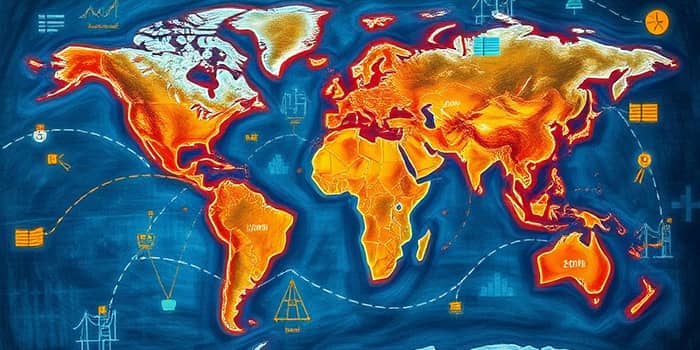
As geopolitical tensions intensify in 2025, investors face a landscape marked by uncertainty and opportunity. Understanding the evolving balance of power and its effects on markets is essential. This article examines core geopolitical flashpoints and translates them into practical investment guidance.
Global power dynamics have reshaped trade, finance, and security. From the US-China rivalry to regional conflicts, each development sends ripples through markets.
Key flashpoints include:
The centerpiece is the US-China rivalry driving uncertainty in trade. Export controls, blacklists, and a “porcupine” deterrence approach have initiated a gradual decoupling of supply chains and finance. Meanwhile, the unresolved war in Ukraine, amplified by ongoing economic sanctions on Russia, continues to stress European energy security and commodity markets.
In the Middle East, the Israel-Hamas conflict has elevated global inflationary pressures. In Asia, nonmilitary standoffs in the South China Sea and potential flashpoints in the Taiwan Strait and Korean Peninsula further heighten risk. Across regions, rise of nationalism and protectionism is prompting tariffs, subsidies, and diversification of import sources.
Geopolitical events in early 2025 have triggered profound market volatility and risk. Equities, fixed income, and crypto have each felt the shock waves of policy shifts and conflict dynamics.
In fixed income markets, trade tensions caused a significant widening of corporate bond spreads, especially in high-yield segments. Credit quality ratios deteriorated as geopolitical uncertainty rose, prompting Moody’s to downgrade the US to Aa1 in May 2025.
Crypto markets, though down 10% in valuation during the first half of 2025, remain robust with EUR 3 trillion in trading volume—near historical peaks. Yet political reviews of digital assets and new token business models continue to fuel speculative swings.
Trade flows have slowed, with S&P Global data showing declining exports across major economies. Governments and multinational firms are actively reshaping supply chains to mitigate disruptions and diversify sources of critical minerals.
As geopolitical blocs form, international finance risks fragmentation into rival rival blocs. China reduces US asset holdings, Russia cuts ties with Western finance, and advanced economies deepen internal partnerships.
While risks abound, strategic sectors offer compelling growth prospects. National security themes, energy transition, and digital infrastructure stand out.
Investors can leverage national security-related investments including defense cybersecurity to capture long-term tailwinds from rising defense budgets and cyber hardening efforts. Energy markets are also in flux: the post-Ukraine shock has spurred increased investment in renewable energy, driven by policies like the US Inflation Reduction Act.
Fossil fuel–dependent nations are resisting the energy shift, potentially igniting further geopolitical friction. Meanwhile, critical minerals—lithium, cobalt, rare earths—are central to both defense systems and green technologies.
Friendshoring initiatives and bilateral supply–chain partnerships provide new avenues for investors. By aligning with government-backed projects in semiconductors, advanced manufacturing, and critical infrastructure, stakeholders can secure stable revenue streams in an unpredictable environment.
To thrive amid volatility, investors must adopt robust process and mindset shifts. Scenario analysis, diversification, and active monitoring are vital.
A few practical steps include:
Advisors should heed scenario planning and adaptability are essential to withstand sudden policy pivots. Tightening credit conditions may require shifting duration exposures, while supply‐chain reconfigurations could open equity opportunities in emerging markets friendly to Western alliances.
Cybersecurity is another priority. The digitization of energy grids and industrial networks introduces new vulnerabilities. Investors should evaluate companies’ resilience frameworks and exposure to state-sponsored cyber threats.
Geopolitical tensions in 2025 present a double-edged sword. Heightened uncertainty drives market swings and credit stresses, yet it also creates fertile ground for strategic investments.
Key imperatives for investors include:
Remaining vigilant on policy shifts, embracing characterized by elevated uncertainty and volatility, and steering capital toward sectors fortified by national security and energy transition mandates.
Ultimately, a balanced approach—anchored in rigorous analysis, diversified exposures, and proactive engagement—will enable investors to navigate the evolving geopolitical landscape and harness its transformative potential.
References