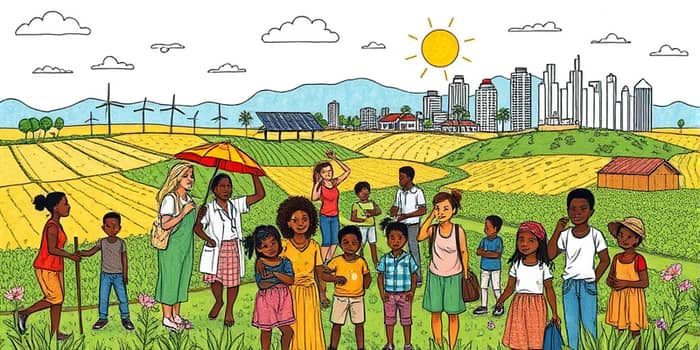
In 2025, despite remarkable strides against extreme poverty, over 800 million people still survive on less than $3 per day. This article explores the journey from historic declines to present challenges, offering actionable insights for sustainable change and spotlighting successful interventions that can be scaled globally.
By examining data, case studies, and policy approaches, we aim to inspire policymakers, practitioners, and concerned citizens to accelerate progress toward a world free of deprivation.
The battle against extreme poverty has seen unprecedented success in recent decades. From 2.3 billion people living below the poverty line in 1990, figures fell to around 808 million by 2025. This represents an average reduction of 42.9 million individuals per year, driven by economic expansion, globalization, and targeted social programs.
Global poverty rates dropped from over 35% in 1990 to a projected 9.9% in 2025. However, if current trends persist, nearly 8.9% of humanity—around 700 million people—will remain in extreme poverty by 2030, leaving many nations short of Sustainable Development Goal targets.
Poverty is unevenly distributed, with Sub-Saharan Africa bearing the heaviest burden. In 2022, nearly 45.5% of its population lived in extreme poverty, while South Asia, despite progress, still counts 380 million poor individuals exposed to climate risks.
The Middle East and North Africa witnessed a reversal, with poverty rates rising from 8.5% in 2022 to 9.4% in 2025. Even advanced economies face pockets of hardship: child poverty in the U.S. reached 13.4% in 2024.
Research consistently shows that well-designed social protection and income transfers deliver the most immediate poverty reduction. In South Korea, means-tested public cash transfers are highly effective, reducing poverty among households with a disabled member by 55.9%.
In the United States, the 2021 expansion of the Child Tax Credit and Earned Income Tax Credit halved child poverty, lifting 6.8 million people above the threshold. Retraction of these benefits led to poverty resurgence, underlining the need for policy continuity.
Quality education and workforce training bolster earning potential over the long term. Programs that combine minimum wage policies with vocational training have shown success in both urban and rural settings. Health insurance coverage and targeted nutrition assistance further protect families from health-related shocks.
Indonesia’s shift to data-driven policymaking improved targeting of subsidies and social programs, increasing cost-effectiveness. South Africa’s child grant and pension schemes reduced inequality and improved school attendance. These successes emphasize the value of tailored, evidence-based interventions aligned with local contexts.
In rural Bangladesh, community works programs not only provide income but also build climate-resilient infrastructure, demonstrating how poverty alleviation and environmental adaptation can be mutually reinforcing.
Despite proven models, obstacles persist. Financing universal social protection floors requires an additional $1.4 trillion annually in low- and middle-income countries. Policy backsliding risks eroding gains, as seen in partial rollbacks of U.S. tax credits.
To achieve lasting reductions in poverty, stakeholders must champion multidimensional approaches targeting health, education and social protection simultaneously. Strengthening local institutions and civil society partnerships ensures interventions remain relevant and adaptable.
Eradicating extreme poverty is achievable if governments, the private sector, and communities commit to comprehensive, resilient policies. By learning from successful case studies and maintaining momentum, the world can ensure that future generations inherit a legacy of equity and opportunity.
Together, through informed action and shared responsibility, we can realize a future where poverty is not a fate but a chapter in history, forever closed.
References