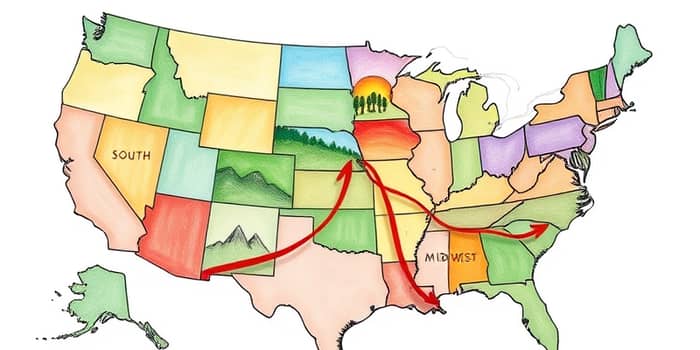
The United States in 2025 faces a moment of profound economic divergence. While some areas surge ahead, others struggle with slowing growth and employment shifts. Understanding these patterns is vital to crafting strategies that ensure all regions share in the nation s prosperity.
In Q1 2025, growth decelerated across every region, with the West experiencing the sharpest regional slowdown. Volatile tariffs and heightened uncertainty weighed on investment, while a softening labor market dampened consumer confidence.
Nationally, real GDP rose at an annual rate of 3.8 percent in Q2, yet state-level outcomes varied dramatically, from a stellar 7.3 percent gain in North Dakota to a contraction of 1.1 percent in Arkansas. Personal income climbed uniformly, but unemployment, though low by historical norms, is projected to exceed 4.5 percent by year end, with the highest rates in the West.
Each U.S. region exhibits unique strengths and vulnerabilities, underscoring the need for tailored policy and investment approaches.
South
The South leads in job creation, consumer spending, and overall output, boasting the fastest-growing economy in the nation. Population grew by 1.4 percent year-on-year through mid-2024, driven by robust domestic migration and attractive living costs. Key sectors include retail, leisure, hospitality, and technology hubs in Alabama, Kentucky, Mississippi, and Tennessee. Strong export demand—absent retaliatory tariffs—continues to fuel growth in Texas and Florida.
Despite this momentum, certain areas confront headwinds. Federal workforce reductions in Maryland, the District of Columbia, and Virginia shave employment figures. Manufacturing faces pressure from import tariffs, though less intensely than in the Northeast. Yet low unemployment rates in Florida, Georgia, North Carolina, and Tennessee underscore the South s resilience as it attracts 42 percent of recent international migrants.
Northeast
GDP growth in the Northeast aligns with the national average but trails the Southern surge. Wage gains and high-income migration support consumer spending, especially around major metropolitan corridors. Financial activities and healthcare bolster job growth, though Connecticut and Maine have seen employment decline, and states like New York, New Jersey, and New Hampshire experience slower expansion.
Populations in the region grew at 0.8 percent through mid-2024, the highest net migration rate of 9.1 per thousand residents, yet forecasts predict a slight contraction of 0.2 percent by the end of 2025. Tourism headwinds and nonprofit funding cuts due to federal austerity measures deepen challenges, while manufacturing jobs have contracted more sharply here than in any other region. Still, tight housing inventory is fueling continued home price growth, mirroring the Midwest s pace.
Midwest
The Midwest lags behind, with manufacturing and agriculture squeezed by high interest rates, trade disruptions, inflation, and cautious consumer spending. Real GDP growth remains below the national pace, and population growth is the slowest, rising just 0.1 percent by late 2025.
Transportation equipment manufacturing, particularly new automotive and EV plants, offers pockets of resilience, but the broader industrial base is contracting. Housing affordability is the region s silver lining, providing a supportive backdrop for households even as other costs rise. Nevertheless, persistent inflation and trade pressures hamper a more robust recovery.
West
The West experienced the steepest deceleration from 2.9 percent year-on-year growth in Q4 2024 to 1.8 percent in Q1 2025. Tech job losses in California, a six-month decline in Las Vegas tourism, and tariff impacts weigh heavily on regional output.
Population growth slowed from 1.0 percent to 0.3 percent projection by year end. States like Arizona, Utah, and Idaho find strength in domestic migration and new investment flows, but high living costs and restrictive policies dampen momentum. Unemployment growth outpaced other regions, reflecting cooling demand and structural tightness in labor markets.
Addressing these disparities requires coordinated efforts from government, industry, and communities. Stakeholders must focus on inclusive strategies to uplift lagging areas while sustaining growth engines.
The divergent economic trajectories of U.S. regions in 2025 underscore the need for intentional, data-driven solutions. By leveraging metropolitan strengths and regional assets, policymakers and business leaders can forge pathways toward a more balanced, resilient national economy. Bridging these gaps is not only an economic imperative but a moral one, ensuring that every community can thrive in the years ahead.
References