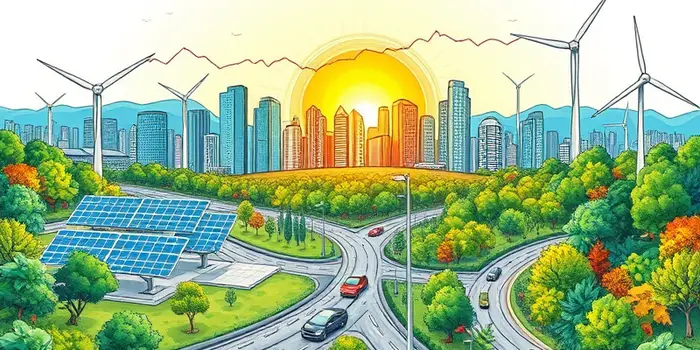
The global shift toward sustainability is no longer just a moral imperative—it’s a powerful economic engine. Businesses and investors are discovering how pioneering green technologies can deliver substantial returns while advancing climate goals.
The term climate economy encompasses all economic activities that reduce greenhouse gas emissions, enhance resource efficiency, and preserve biodiversity. It spans clean energy, sustainable agriculture, green buildings, and waste management, among other areas.
At its heart, the climate economy thrives on emissions reduction and resource efficiency, creating solutions that benefit both the planet and the bottom line.
Recent estimates place the climate tech market at $31.68 billion in 2025, with projections soaring to $235.05 billion by 2034 (CAGR 24.9%). Alternative forecasts cite a baseline of $38.5 billion in 2024, reaching $115.4 billion by 2030 (CAGR 20.9%). Beyond climate tech, the broader green economy stood at $7.92 billion in 2024, on track to hit $29.97 billion by 2033 (CAGR 15.6%).
These figures underscore the rapidly expanding financial landscape fueling innovation across multiple industries.
Certain sectors lead the charge in both adoption and returns. Energy & Utilities held over 33% of end-user share in 2024, driven by grid modernization and renewables integration. Transportation & Logistics is the fastest-growing end user, buoyed by electrification and smart routing technologies.
By targeting inefficiencies and leveraging new technologies, these sectors are unlocking substantial margin improvements and market share gains.
Geography plays a pivotal role in shaping market dynamics. North America currently accounts for approximately 35–37% of the climate tech market, thanks to a public awareness and government support that fosters innovation. Europe follows closely, driven by stringent ESG standards and emission trading systems.
Asia-Pacific stands out as the fastest-growing region, led by China’s massive clean energy investments and India’s solar expansion.
The U.S. climate tech segment alone grew to $6.57 billion in 2024, with estimates projecting $62.14 billion by 2034 (CAGR 25.19%).
Climate finance has emerged as a critical enabler of green innovation. The carbon finance market is projected to escalate from $732.9 million in 2025 to $4.84 billion by 2032 (CAGR 31%). Corporations seeking to meet net-zero targets are fueling the voluntary carbon segment, which commands 53.1% of the market.
These mechanisms not only channel capital into high-potential startups but also provide investors with attractive risk-adjusted returns compared to traditional asset classes.
Breakthroughs in key technologies are accelerating climate solutions at scale. Solar photovoltaics and wind power continue to dominate due to cost declines and improved grid integration. Advances in battery chemistry and energy storage systems are critical to balancing intermittent supply.
Electric vehicles are disrupting transportation, supported by public and private investment in charging infrastructure. Carbon capture, utilization, and storage (CCUS) is expanding under stringent policy mandates, while nature-based solutions like reforestation deliver both carbon sequestration and biodiversity benefits.
voluntary segment leads with fifty-three percent of the carbon finance market, reflecting strong corporate demand for high-quality offsets.
Despite its promise, the climate economy faces hurdles. Startups often require patient, long-term capital, and many burn cash rapidly before scaling. Political shifts can introduce carbon neutrality targets and emissions standards uncertainty, affecting subsidy regimes and pricing mechanisms.
Moving from pilot projects to commercial-scale operations can create manufacturing bottlenecks, while intense competition may compress margins and shorten product lifecycles.
Looking ahead, the convergence of technology, policy, and finance suggests the climate economy will continue its upward trajectory. Corporate net-zero pledges and increasing climate finance flows underpin forecasts of sustained high growth through 2034.
Asia-Pacific is poised to outpace North America in growth rate, driven by state-led manufacturing, urbanization, and renewable energy deployment. Emerging opportunities include green hydrogen, advanced materials with circular designs, and digital climate services.
The climate economy represents a rare alignment of environmental stewardship and economic opportunity. By investing in and adopting green innovations, businesses can achieve renewable energy mandates and ESG investing goals while capturing new revenue streams.
As regulators, consumers, and investors double down on sustainability, the companies and regions that embrace this transformation will secure not only a competitive edge but also a healthier planet for future generations.
References